
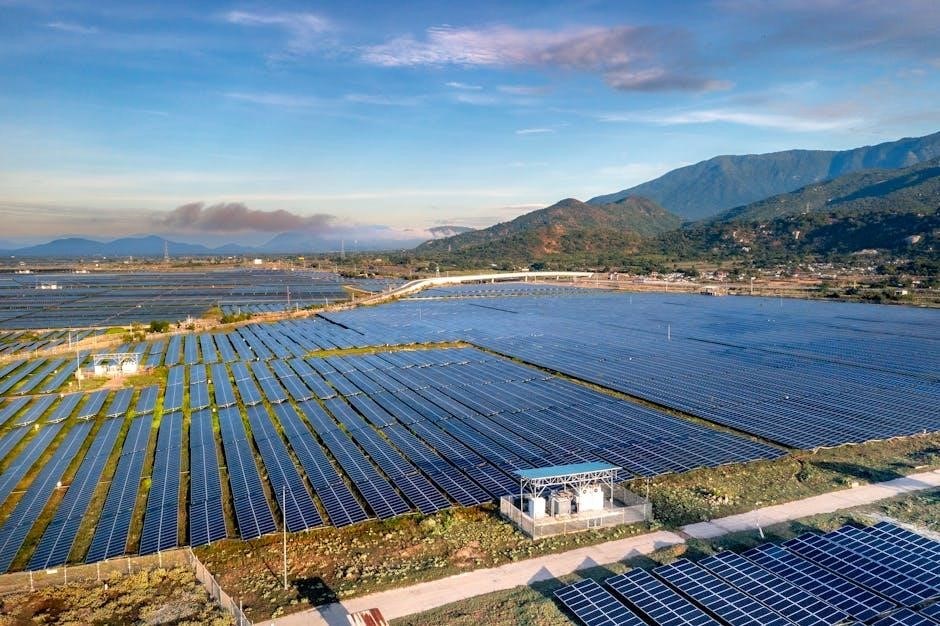
Solar Angle Guide: Understanding the Sun’s Position
Harnessing solar energy requires precise knowledge of the sun’s location; this guide details angles crucial for optimal energy capture and application.
What are Solar Angles?
Solar angles are measurements defining the sun’s position relative to a specific location on Earth. These aren’t fixed; they constantly change based on time of day, date, and geographical location. Essentially, they describe where the sun appears in the sky.
Two primary angles are commonly referenced: altitude and azimuth. Altitude represents the sun’s height above the horizon, while azimuth indicates its compass direction. Understanding these angles is fundamental for anyone working with solar energy, architecture, or even photography, as they dictate light intensity and direction.
Why are Solar Angles Important?
Knowing solar angles is critical for maximizing the efficiency of solar energy systems. Accurate angle calculations ensure solar panels are positioned to receive the most direct sunlight throughout the year, boosting energy production.
Beyond energy, these angles impact architectural design, allowing for passive solar heating in winter and shading in summer. Photographers utilize this knowledge to capture optimal lighting conditions during the “golden hour.” Essentially, understanding solar angles allows for informed decisions, optimizing performance and resource utilization across diverse fields.
Key Solar Angles Explained
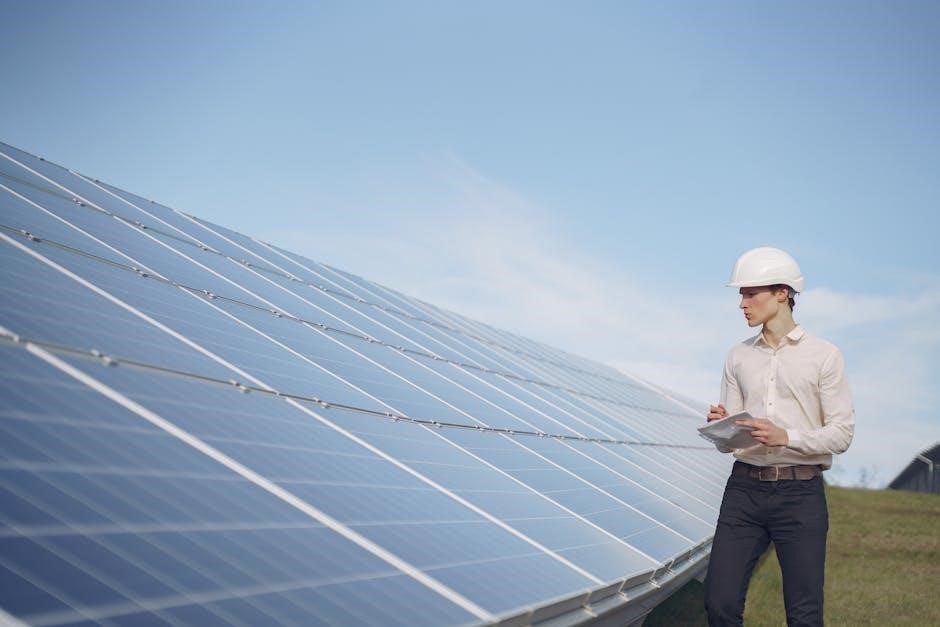
Three primary angles – altitude, azimuth, and incidence – define the sun’s position; mastering these is fundamental for solar applications and calculations.
Solar Altitude Angle
The solar altitude angle represents the sun’s height above the horizon, measured in degrees. It’s a crucial indicator of solar intensity, directly impacting the amount of energy reaching a specific location. A higher altitude angle signifies a more direct sunlight path, resulting in greater energy concentration. Conversely, a lower angle means sunlight travels through more atmosphere, leading to scattering and reduced intensity.
This angle dynamically changes throughout the day, peaking at solar noon and decreasing towards sunrise and sunset. Understanding altitude is vital for applications like solar panel positioning, daylighting design, and even predicting shadow lengths. Accurate altitude calculations are essential for maximizing solar energy utilization.
Defining Solar Altitude
Solar altitude is defined as the angle between the horizon and a direct line to the sun. Imagine a right triangle formed by your location, the zenith (point directly overhead), and the sun. The altitude angle is one of the acute angles within this triangle. It’s measured in degrees, ranging from 0° at sunrise/sunset to 90° when the sun is directly overhead at solar noon.
This measurement isn’t simply looking “up” at the sun; it requires accounting for the Earth’s curvature and atmospheric refraction. Precise determination relies on astronomical calculations considering latitude, longitude, date, and time.
Factors Affecting Solar Altitude
Several key factors influence solar altitude. Latitude is primary; locations closer to the equator generally experience higher maximum solar altitudes. Time of year, due to Earth’s axial tilt, dramatically alters the sun’s path, resulting in higher altitudes during summer and lower ones in winter.
Time of day also plays a crucial role, with the sun reaching its peak altitude at solar noon. Atmospheric conditions, like air density and temperature, cause refraction, slightly altering the apparent altitude. Finally, elevation above sea level increases the observed solar altitude.
Solar Azimuth Angle
The solar azimuth angle defines the sun’s horizontal position relative to true north. Measured clockwise from north, it ranges from 0° to 360°. Understanding azimuth is vital for accurately tracking the sun’s movement throughout the day and across seasons.
This angle is crucial for orienting solar panels and designing shading structures. It’s also essential in architectural planning to maximize daylighting and minimize unwanted solar heat gain. Accurate azimuth determination requires considering location, date, and time.
Understanding Solar Azimuth Measurement
Measuring solar azimuth involves determining the compass direction of the sun. Traditionally, a specialized instrument called a sextant was used, but modern methods rely on calculations and digital tools. True north is the reference point, differing from magnetic north due to local magnetic declination.
Accurate measurement requires correcting for this declination. Online calculators and smartphone apps simplify this process, providing precise azimuth angles based on location and time. Understanding these nuances ensures correct solar panel orientation and accurate shading analysis.
How Azimuth Impacts Solar Applications
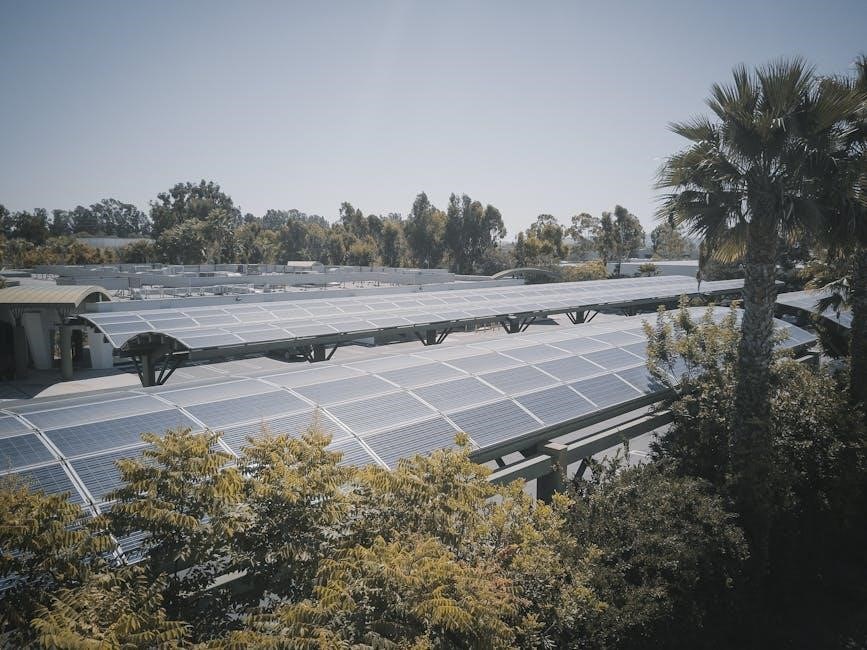
Solar azimuth directly influences the efficiency of solar energy systems. For photovoltaic (PV) panels, accurate azimuth alignment maximizes sunlight exposure, boosting energy production throughout the day. Incorrect alignment leads to significant power losses.
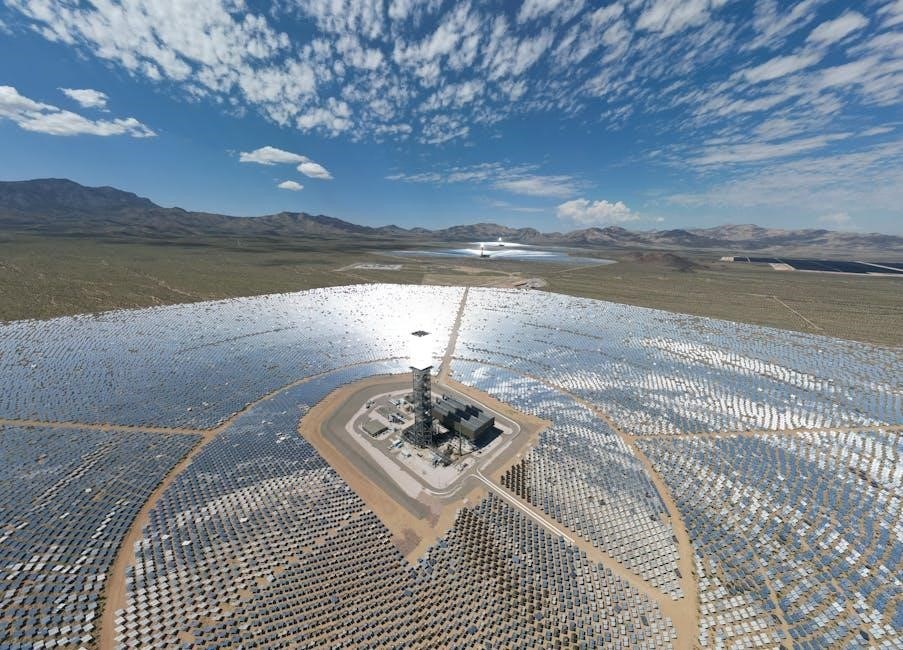
In solar thermal applications, like concentrated solar power, precise tracking based on azimuth is vital for focusing sunlight onto a receiver. Furthermore, architects utilize azimuth data for passive solar design, optimizing building orientation to leverage sunlight for heating and minimizing unwanted solar gain.
Angle of Incidence
The angle of incidence is the angle between a ray of sunlight and a line perpendicular to a surface – crucially impacting energy absorption. A 0-degree angle signifies direct, perpendicular sunlight, maximizing energy transfer. As the angle increases, sunlight spreads over a larger area, reducing energy density.
Understanding this angle is paramount for optimizing solar technologies. Minimizing the angle of incidence enhances the performance of solar panels and concentrating solar collectors, leading to greater efficiency and overall energy yield. Accurate calculations are therefore essential.
Calculating the Angle of Incidence
Determining the angle of incidence involves several factors: solar altitude, solar azimuth, surface orientation (tilt and azimuth), and the time of day and year. Complex formulas utilizing spherical trigonometry are often employed, but simplified approximations exist for specific scenarios.
Online calculators and specialized software greatly simplify this process, requiring input of location, date, time, and surface parameters. Accurate calculations are vital for predicting solar energy availability and optimizing system performance. Ignoring this angle leads to significant energy loss.
Importance in Solar Panel Efficiency
The angle of incidence directly impacts how much solar radiation reaches the panel’s surface; When sunlight strikes perpendicularly (0° incidence), energy transfer is maximized. As the angle increases, more sunlight is reflected, reducing the energy absorbed by the photovoltaic cells.
Minimizing the angle of incidence through tracking systems or optimal fixed-tilt angles significantly boosts energy production. Even small deviations can lead to substantial efficiency losses over time, impacting the return on investment for solar installations.

Tools for Determining Solar Angles
Various instruments and resources, from digital calculators to physical pathfinders, assist in accurately determining solar angles for diverse applications and locations.
Solar Angle Calculators (Online & Apps)
Digital solar angle calculators represent a convenient and accessible method for determining the sun’s position at any given time and location. These tools, available both as web-based applications and mobile apps, utilize complex algorithms incorporating latitude, longitude, date, and time to provide precise angle measurements.
They eliminate the need for manual calculations and offer real-time updates, making them invaluable for professionals and enthusiasts alike. Many calculators also feature graphical representations of the sun’s path, enhancing understanding and facilitating planning for solar-related projects.
Accuracy is generally high, though it’s wise to verify results with other methods when precision is paramount.
Benefits of Using Calculators
Employing solar angle calculators delivers numerous advantages, primarily speed and accuracy. Manual calculations are time-consuming and prone to error; calculators provide instant, reliable results. They simplify complex astronomical computations, making solar analysis accessible to a wider audience without specialized expertise.
Furthermore, calculators often incorporate features like daylight savings time adjustments and timezone support, ensuring precision. Their portability, especially in app form, allows for on-site measurements and quick adjustments during installation or observation. This efficiency translates to cost savings and improved project outcomes.
Popular Calculator Options
Several excellent solar angle calculators are readily available. SunCalc (suncalc.org) offers a visually intuitive interface displaying solar positions on a map. The NOAA Solar Calculator (esrl.noaa.gov/gmd/grad/solcalc/) provides detailed data for specific locations and times.
For mobile users, apps like Photovoltaic Geometry and Sun Surveyor are highly rated, offering augmented reality features for precise angle measurements. These tools often include features for solar panel orientation and shading analysis. Each option caters to different needs, from simple estimations to professional-grade assessments.
Solar Pathfinders & Charts
Solar pathfinders, like the SunEye, are physical tools used to map the sun’s path across the sky throughout the year. They visually represent potential shading obstructions, crucial for site analysis. Solar path charts, often circular diagrams, illustrate the sun’s altitude and azimuth angles for any given time and date.
These charts are invaluable for understanding seasonal variations and predicting solar access. Interpreting them requires understanding the chart’s projection and how it relates to the local horizon. Both methods offer a tangible, location-specific understanding of solar movement.
How Solar Pathfinders Work
A solar pathfinder utilizes a reflective dome and a viewing screen to project a panoramic view of the surrounding horizon. The dome mirrors the sky, displaying the sun’s position at various times of the year. By tracing the sun’s path on the screen, users can identify potential shading obstacles – trees, buildings, or terrain.
This allows for accurate assessment of solar access, determining periods of direct sunlight and shadow. The device essentially compresses a year’s worth of solar movement into a single, observable image, simplifying site analysis.
Interpreting Solar Path Charts
Solar path charts, also known as sun path diagrams, graphically represent the sun’s position throughout the year for a specific latitude. Concentric curves indicate solar altitude angles, while radiating lines denote solar azimuth angles. The chart’s center represents the horizon, and the sun’s path is traced across it.
Understanding these charts requires identifying the date and time of interest, locating the corresponding point on the diagram, and reading the associated altitude and azimuth values. This reveals the sun’s precise location in the sky.
Seasonal Variations in Solar Angles
The Earth’s tilt causes significant shifts in solar angles throughout the year, impacting daylight hours and the sun’s intensity at different latitudes.
Solar Angles in Summer
During the summer months, the Northern Hemisphere is tilted towards the sun, resulting in a higher solar altitude angle throughout the day. This means the sun appears higher in the sky, leading to more direct sunlight and increased solar irradiance. Consequently, days are significantly longer, providing extended periods of potential solar energy capture.
The solar azimuth angle shifts gradually, but generally remains within a more northerly arc compared to winter. This higher sun position and extended daylight hours are key factors in maximizing solar energy production during summer, making it the most productive season for solar installations. Understanding these shifts is vital for optimizing system performance.
Higher Altitude & Longer Days
The summer solstice marks the peak of the sun’s high trajectory, resulting in the year’s highest solar altitude angle. This elevated position delivers more concentrated solar radiation, boosting energy gains. Simultaneously, the Earth’s axial tilt causes significantly longer daylight hours, extending the period for solar energy collection.
These combined factors – increased altitude and extended duration – dramatically enhance the potential for solar power generation; This is why summer consistently yields the highest energy output from solar panel systems. Careful consideration of these angles is crucial for maximizing efficiency.
Solar Angles in Winter
During the winter months, the sun traces a lower arc across the sky, resulting in significantly reduced solar altitude angles. This lower position means sunlight travels through more of the atmosphere, lessening its intensity before reaching the Earth’s surface.
Furthermore, daylight hours are considerably shorter, limiting the overall time available for solar energy capture. These diminished angles and durations present challenges for solar energy systems, requiring careful planning and potentially adjustments to panel orientation to optimize performance during this season.
Lower Altitude & Shorter Days
Winter’s defining characteristic is the sun’s dramatically lower altitude angle, meaning it appears much lower in the sky throughout the day. Coupled with this is a significant reduction in daylight hours; the sun spends less time above the horizon.
This combination leads to weaker sunlight and less overall solar radiation reaching any given location. Consequently, solar energy systems experience reduced output, necessitating adjustments like steeper panel angles to intercept the available sunlight effectively and maximize energy generation.
Equinox Solar Angles
During the spring and autumn equinoxes, the sun crosses the celestial equator, resulting in nearly equal day and night lengths globally. Solar angles at these times represent a transitional phase between summer and winter extremes.
The solar altitude is moderate, falling between the higher summer angles and the lower winter angles. The azimuth angle shifts predictably, and the angle of incidence on surfaces is also intermediate. These balanced conditions offer a stable baseline for solar applications, simplifying calculations and system optimization.
Balanced Day and Night
The defining characteristic of the equinoxes – spring and autumn – is the near-equal duration of daylight and darkness across most of the Earth. This phenomenon occurs because the sun is positioned directly above the equator during these periods.
Consequently, the sun rises due east and sets due west, resulting in a symmetrical path across the sky. This balance simplifies solar angle calculations, as the sun’s trajectory is predictable and consistent. It’s a pivotal time for observing and understanding solar patterns.

Practical Applications of Solar Angle Knowledge
Understanding solar angles unlocks efficiency gains in diverse fields, from renewable energy systems to architectural design and even artistic photography.
Solar Panel Installation Optimization
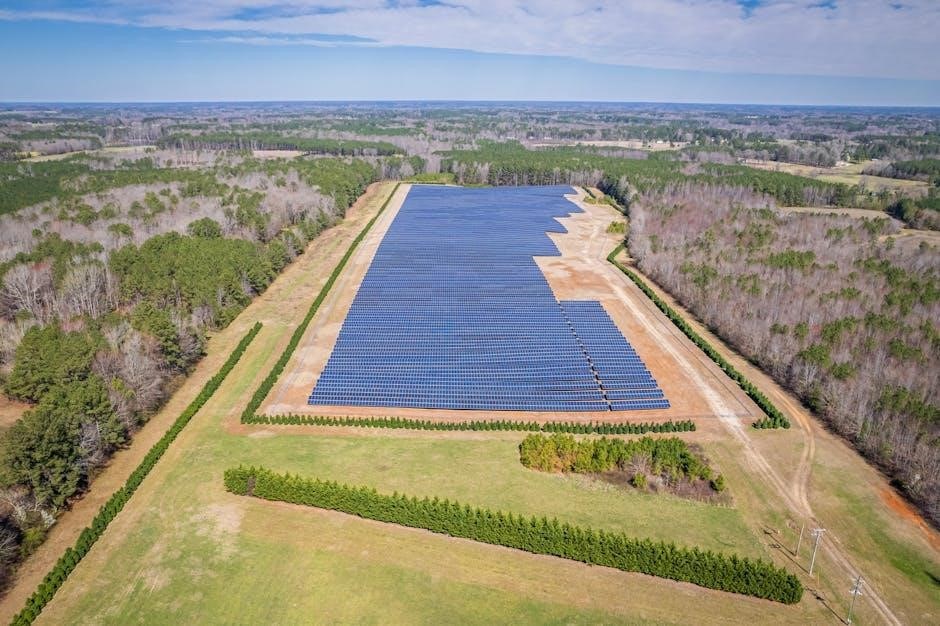
Precise solar angle calculations are paramount for maximizing energy production from photovoltaic (PV) systems. Tilting panels at the optimal altitude angle, based on latitude and season, ensures direct sunlight exposure.
Adjusting the azimuth angle correctly minimizes shading and captures the sun’s peak intensity throughout the day. Tracking systems dynamically adjust both angles, following the sun’s path for consistently high output.
Ignoring these angles leads to significant energy losses, reducing the return on investment. Careful consideration of local conditions and accurate angle determination are essential for efficient solar panel installations.
Maximizing Energy Production
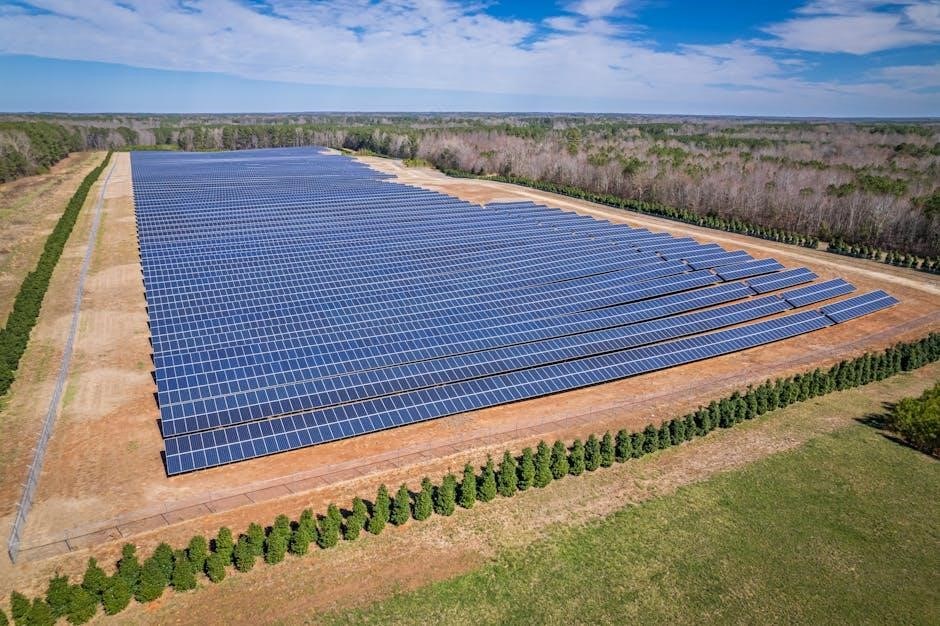
To achieve peak performance, solar panels must receive direct sunlight for the longest possible duration. This is accomplished by aligning the panels perpendicular to the sun’s rays, minimizing reflective losses.
Optimizing tilt angle seasonally – steeper in winter, shallower in summer – significantly boosts energy yield. Utilizing solar tracking systems, which follow the sun’s movement, provides the greatest gains, increasing output by up to 40%;
Regularly assessing and adjusting panel angles, coupled with shading analysis, ensures consistent and maximized energy production throughout the year.
Architecture & Building Design
Integrating solar angle understanding into building design yields substantial benefits. Passive solar heating leverages winter sun exposure through south-facing windows, reducing heating costs. Conversely, strategic overhangs and shading devices block high-angle summer sun, minimizing cooling loads.
Building orientation, window placement, and material selection all play crucial roles. Careful consideration of solar paths informs designs that maximize natural light while controlling heat gain. This approach fosters energy efficiency and occupant comfort.
Ultimately, solar-responsive architecture creates sustainable and aesthetically pleasing structures.
Passive Solar Heating & Cooling
Passive solar design utilizes a building’s structure to regulate temperature without mechanical systems. In winter, low solar angles allow sunlight to penetrate windows, warming thermal mass materials like concrete or brick, storing heat for later release.
Summer strategies involve shading devices – overhangs, awnings, or vegetation – blocking high-angle sun. Natural ventilation, guided by prevailing winds and building orientation, further enhances cooling.
Effective passive systems minimize energy consumption, creating comfortable indoor environments while reducing reliance on conventional heating and cooling.
Photography & Lighting
Photographers leverage solar angles for dramatic lighting effects. The “golden hour,” shortly after sunrise and before sunset, features low angles creating warm, soft light and long shadows – ideal for portraits and landscapes.
Conversely, the “blue hour,” occurring before sunrise and after sunset, offers cool, diffused light. Understanding azimuth and altitude helps predict light direction and intensity.
Architectural photographers utilize angles to highlight building features, while filmmakers plan shoots around sun position for consistent illumination.
Golden Hour & Blue Hour Effects
The golden hour, with its low solar altitude, casts a warm, reddish glow, enhancing textures and creating a pleasing aesthetic. This occurs when the sun is below 6 degrees above the horizon.
Blue hour, following or preceding the golden hour, presents a cooler, softer light as the sun dips further below the horizon. This diffused light minimizes harsh shadows.
Photographers capitalize on these angles for stunning visuals, while filmmakers utilize them for mood and atmosphere.